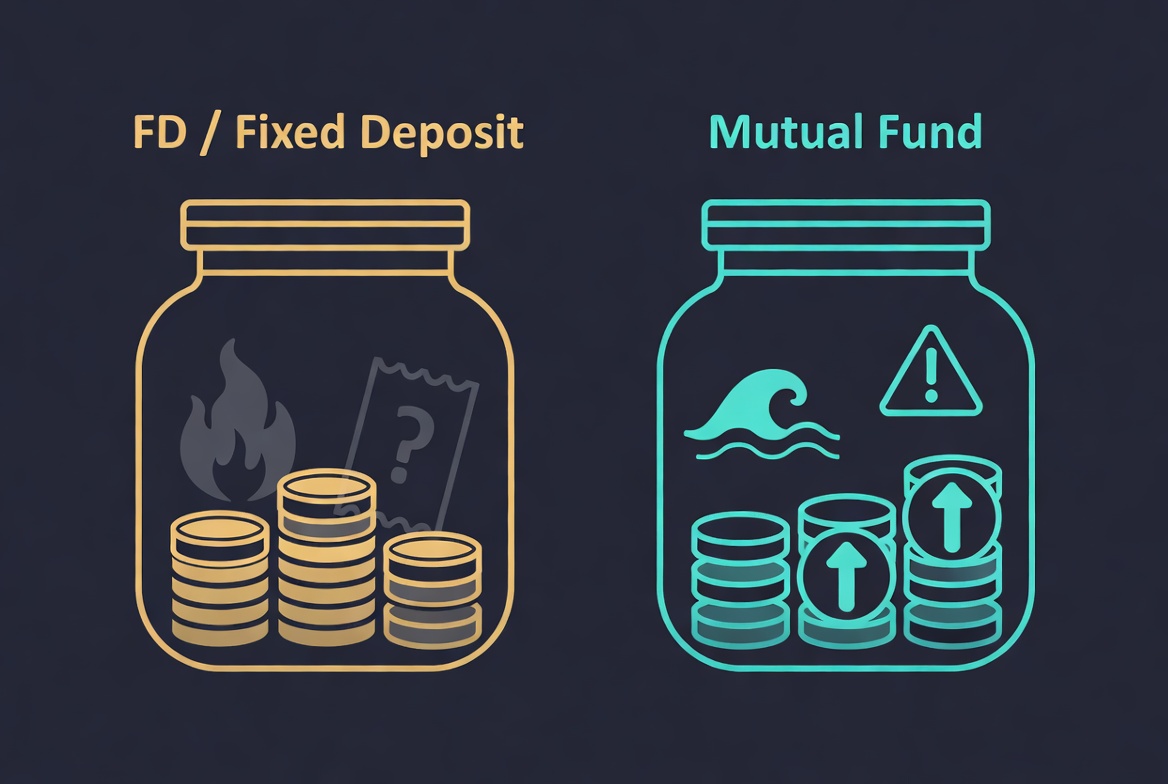
Profit Known vs Risk Known: The Framework That Reframes the FD vs MF Debate
Published · Updated
FDs tell you the profit but hide the risks (inflation, tax, reinvestment). Mutual funds tell you the risks upfront but leave the profit unknown. Which model builds more real wealth over 15 years?
Jun 2025 · 10 min read · By Subhavani Nemalikanti
6–7%Typical FD return — often below inflation post-tax
11–13%Historical long-term equity mutual fund CAGR
30%+Real return eroded by inflation + taxation on FDs
Geeta, a 52-year-old school principal, puts ₹10 lakh in a 5-year FD every year. "Mutual funds are too risky," she says. "I know exactly what I'm getting from my FD."
Her neighbour Prakash, same age, same income, invests ₹10 lakh in a large-cap index fund SIP. "I know the market can fall," he says. "But I also know it has always recovered, and I know exactly what risks I'm taking."
At first glance, Geeta seems more prudent. But when you trace both approaches over 15 years — accounting for inflation, taxation, and actual purchasing power — Prakash consistently comes out significantly ahead. And the reason is simple but profound: Geeta's risk is real. It's just hidden. Prakash's risk is real too — but it is transparent, manageable, and historically rewarded.
The Core Concept: Two Fundamentally Different Risk Postures
💰 "Profit is Known" — FD, PPF, NSC
You know the return. You do not know what risks you are actually carrying.
✅
Return is fixed and predictable at the time of investment
✅
Capital guaranteed (up to ₹5L per bank under DICGC)
⚠️
Inflation risk is invisible — ₹1L today is not ₹1L in 10 years
⚠️
Tax on interest is certain — fully taxed at your slab rate
⚠️
Reinvestment risk — interest rates may fall when FD renews
⚠️
Opportunity cost — equity markets may generate 3–5x more over 15 years
📈 "Risk is Known" — Equity Mutual Funds
You know the risks. The return is uncertain — but historically significant.
⚠️
Market can fall 20–50% in the short term — this is visible and expected
⚠️
No capital guarantee — NAV fluctuates daily
✅
All risks disclosed: SEBI risk-o-meter, portfolio factsheet, fund mandate
✅
Historically beats inflation by 5–7% real annually over 15+ year periods
✅
Tax-efficient: LTCG at 12.5% (vs FD interest at 30% slab rate)
✅
Risk is time-reducible — longer horizons dramatically reduce loss probability
The Hidden Risks in "Profit is Known" Instruments
The problem with FD risk is not its existence — it is its invisibility. Here are the four risks that FD investors carry without realising it:
💡 Use the SIP calculator to compare ₹5L in an FD at 7% vs ₹5L in an equity fund at 12% over 15 years.
At 7% FD return and 6% inflation, your real return is just 1%. In a high-inflation year (8–9%), your FD loses real value. Every rupee locked in an FD is quietly being eroded in purchasing power.
Real return: ~1% at current rates
🧾
Taxation Risk
FD interest is added to your income and taxed at your slab rate. In the 30% bracket, a 7% FD delivers only 4.9% post-tax. This puts the post-tax real return dangerously close to zero or negative.
Post-tax at 30% slab: ~4.9%
🔁
Reinvestment Risk
When your 1-year or 3-year FD matures, you may not get the same rate. If interest rates have fallen (as they did in 2020–22), your renewed FD earns less — permanently altering your income plan for the next cycle.
2020 FD rates fell to 5–5.5%
🏦
Bank Credit Risk
DICGC insures deposits only up to ₹5 lakh per depositor per bank. Amounts above this are uninsured. Yes-Bank (2020) and PMC Bank (2019) failures exposed this risk to thousands of FD holders across India.
DICGC covers only ₹5L per bank
💹
Opportunity Cost Risk
₹1 lakh in a Nifty 50 index fund over 20 years (at 12% CAGR) becomes ₹9.6 lakh. In an FD at 7% it becomes ₹3.9 lakh. The opportunity cost of staying in FDs over long horizons is enormous — and permanent.
₹5.7L in foregone growth per ₹1L over 20 yrs
The most dangerous risk of all: None of the above risks show up in your FD statement. Your statement shows ₹1,07,000 against ₹1,00,000. It looks safe. It feels safe. The real losses — to inflation, tax, and opportunity — happen silently, off-statement, over decades. That is what makes "profit is known" instruments genuinely risky for long-term wealth creation.
The Known Risks of Mutual Funds — Fully Visible, Fully Manageable
Every risk in a mutual fund is disclosed before you invest. Here is what you are knowingly accepting — and why each is manageable:
Visible Risk
Market/NAV Risk
NAV can fall. Disclosed daily. SEBI risk-o-meter quantifies it. Managed by: holding for 10+ years (no 10-year period in Nifty 50 history has delivered negative returns).
Visible Risk
Concentration Risk
Sector/stock concentration disclosed monthly in factsheet. Managed by: choosing diversified funds or index funds with 50–500 holdings.
Manageable Risk
Liquidity Risk
Equity funds take T+3 days to redeem. Disclosed upfront. Managed by: maintaining Bucket 1 (liquid fund for emergency needs) separate from long-term equity allocation.
Manageable Risk
Sequence-of-Returns Risk
A major crash near retirement can damage the portfolio. Managed by: bucket strategy — shift to debt and hybrid as you approach withdrawal horizon. This is why retirement planning is structured.
Visible Risk
Fund Manager Risk
Active funds depend on manager skill. Managed by: choosing index funds which carry zero manager risk, or selecting funds with consistent 10-year track records under stable management.
Manageable Risk
Expense Ratio Drag
TER reduces returns annually. Disclosed in factsheet. Managed by: choosing direct plans or low-cost index funds (Nifty 50 index funds have TERs as low as 0.1%).
The Reality Check: 15-Year Wealth Comparison
FD vs Equity MF: Real Wealth After Inflation & Tax
Compare the actual purchasing power of both approaches over your time horizon.
FD Nominal Value
Equity MF Value
Cost of ₹1 today (Inflation)
Instrument
Gross Return
Tax Treatment
After-Tax Return
Real Return (after 6% inflation)
Wealth Created (₹5L, 20 years)
Bank FD
7% p.a.
Slab rate (30%)
~4.9% p.a.
~–1.1% real
~₹13.2L
PPF
7.1% p.a.
Tax-free (EEE)
7.1% p.a.
~1.1% real
~₹20.4L
Debt Mutual Fund
7–8% p.a.
12.5% LTCG (24m+)
~6–7% p.a.
~0.5–1.5% real
~₹18–22L
Nifty 50 Index Fund
12% historical CAGR
12.5% LTCG (12m+)
~10.5–11% p.a.
~4.5–5% real
~₹56–63L
Flexi Cap Equity Fund
13–14% historical CAGR
12.5% LTCG (12m+)
~11.5–12.5% p.a.
~5.5–6.5% real
~₹74–90L
Historical CAGR data is indicative. Past performance does not guarantee future returns. Tax calculations are approximate; consult your CA for individual tax planning.
Who Should Be in "Profit Known" vs "Risk Known" Products?
✓ Choose "Profit Known" (FD/Debt) When:
🎯
Specific goal within 1–3 years (wedding, home down payment)
👴
Retired and need guaranteed monthly income with no room for volatility
🚨
Emergency fund — needs to be safe and instantly accessible
💼
Bucket 1 and Bucket 2 in your retirement portfolio
😰
Risk tolerance is genuinely very low and sleeplessness from volatility is a real concern
✓ Choose "Risk Known" (Equity MF) When:
📅
Time horizon is 7 years or more — long enough for compounding to overwhelm volatility
🏗️
Building long-term wealth — retirement corpus, children's education in 12+ years
📊
You understand that volatility is temporary but inflation is permanent
💪
You can stay invested through market corrections without panic-redeeming
🌿
You want tax-efficient wealth — equity LTCG is far more efficient than FD interest income
FAQs
No. FDs carry real risks: inflation risk (purchasing power erosion), tax risk (interest fully taxable at slab), reinvestment risk (rates may fall at renewal), bank credit risk (only ₹5L is insured), and opportunity cost risk (missing equity growth). The risk is real — it is hidden, not absent. For a 10+ year horizon, FDs are often riskier than equity funds in real purchasing power terms.
Every risk in a mutual fund is disclosed, quantified, and manageable. The SEBI risk-o-meter, monthly factsheets, portfolio disclosures, and volatility measures give investors full visibility into what they own and what risks they carry. You can also reduce risk through asset allocation, time horizon extension, and fund diversification — none of which is possible with a hidden FD risk.
At 7% FD rate with 6% inflation and 30% tax, your real post-tax return is approximately –1.1%. Your money grows in nominal terms but shrinks in real purchasing power. Over 20 years, this silent erosion is devastating. Meanwhile, equity funds historically delivered 12% CAGR — giving a real post-tax return of 4–5%, which compounds dramatically over the same period.
No — and that would miss the point. FDs serve critical roles: emergency funds, short-term goals, and risk-averse retirees' immediate income needs. The goal is not to eliminate FDs but to understand that for long-term wealth creation (7+ years), the "safe" choice carries hidden risks that equity funds — with their known, visible, time-reducible risks — do not.
SEBI mandates a risk-o-meter (Low to Very High) on every scheme. Monthly factsheets disclose the full portfolio, sector weights, credit quality (for debt funds), expense ratio, benchmark comparison, and fund manager details. Every risk is visible. This transparency is precisely what makes mutual fund risk "known" — unlike the hidden risks of FDs.
Expert Verdict
The most dangerous words in Indian personal finance are "safe investment." Safety is not an absolute — it depends on what you are being protected against, and over what time horizon. A Fixed Deposit protects your nominal capital. It does not protect your purchasing power, your tax efficiency, your reinvestment rate, or your long-term wealth. These losses are real. They simply happen quietly, without alerting you, across decades of compounding that never occurred.
Mutual funds carry known risks. Market crashes are visible, temporary, and — for the investor who stays the course — historically reversed. The risk in equity investing is not that you will lose permanently; it is that you must tolerate temporary discomfort for permanent reward. The risk in FD investing is the opposite: you feel permanent comfort while quietly, invisibly absorbing permanent wealth erosion. The investor who truly understands this distinction will build her financial life very differently. We encourage every Sampatha Setu investor to start that understanding here.
Ready to Make Your Risk Visible — and Your Wealth Real?
Our advisors can help you understand exactly which risks you are carrying today, and build a portfolio where every risk is known, managed, and compensated.
Disclaimer: This article is for educational purposes only and does not constitute investment advice. Mutual fund investments are subject to market risks. Please read all scheme-related documents carefully before investing. Consult a SEBI-registered financial advisor for personalised advice. Sampatha Setu is an AMFI-registered Mutual Fund Distributor.